
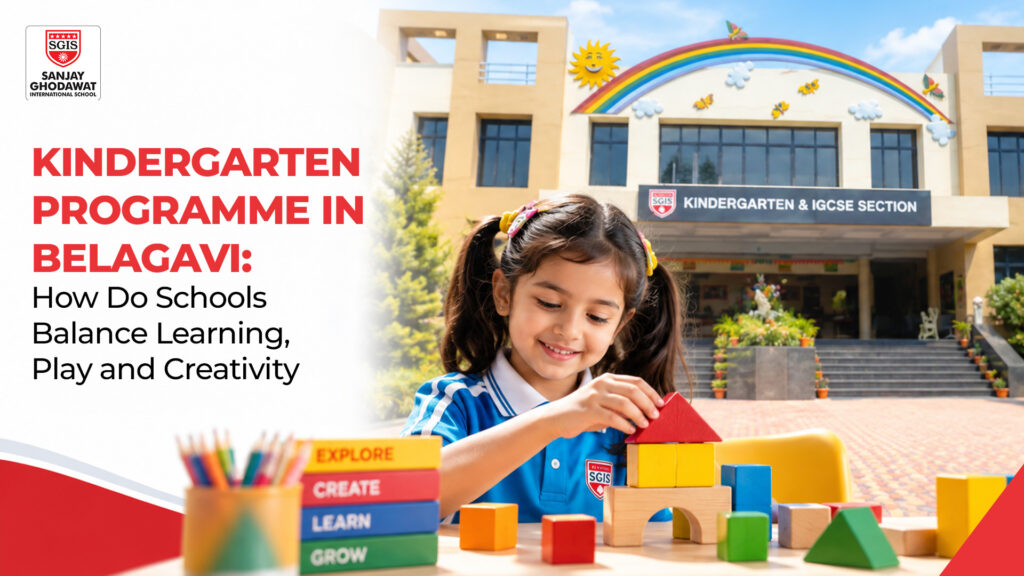
The early years of a child’s education are about much more than learning letters, numbers, and basic concepts. Kindergarten is often the stage when children begin developing their curiosity, communication skills, confidence, and understanding of the world around them.
A well-designed Kindergarten Programme in Belagavi can bring together structured learning, play, creativity, movement, and social interaction. Instead of expecting young children to sit and learn for long periods, schools can create age-appropriate experiences that make learning active, enjoyable, and meaningful. For parents, the important question is not simply “What will my child learn?” but also “How will my child learn?”
Why Balance Matters in Kindergarten
Young children learn differently from older students. They are naturally curious and often understand new ideas better when they can see, touch, move, create, and explore. A balanced kindergarten environment can combine:
- Learning to build foundational knowledge
- Play to encourage exploration and social development
- Creativity to help children express their ideas
- Movement to support physical development
- Interaction to strengthen communication and confidence
The aim is to make each part of the school day contribute to a child’s overall development.
1. Learning Through Age-Appropriate Activities
Kindergarten learning does not have to rely entirely on worksheets or memorisation. Teachers can introduce early literacy, numeracy, language, and general awareness through stories, games, conversations, puzzles, demonstrations, and hands-on activities.
For example, counting objects during a classroom activity can make numbers easier for a child to understand than simply writing numbers repeatedly.
2. Play as a Part of Learning
For young children, play can be an important way to understand the world. Role-play, building blocks, board games, outdoor games, and imaginative activities can encourage children to:
- Explore new ideas
- Make choices
- Interact with classmates
- Solve simple problems
- Follow rules
- Express themselves
This makes play more than just a break between lessons. It can become part of the learning process itself.
3. Creativity Gives Children a Voice
Every child has their own way of expressing ideas. Drawing, painting, music, dance, storytelling, craft, and imaginative play can give children different ways to communicate. Creative activities also allow children to experiment without always worrying about getting a single “correct” answer.
A drawing may look simple to an adult, but for a young child, it can represent an idea, memory, feeling, or story.
4. Learning Through Stories and Imagination
Stories can make unfamiliar concepts easier for young children to understand. A story about sharing can introduce social values. A nature-themed story can encourage curiosity about the environment. A character facing a simple problem can help children think about possible solutions.
When stories are combined with discussion, role-play, or creative activities, children can become active participants rather than simply listeners.
5. Outdoor Play and Physical Development
A kindergarten programme should also give children opportunities to move. Outdoor games, free play, simple exercises, obstacle activities, and coordinated movement can support physical development while giving children opportunities to interact with others.
Physical activity can also provide a change of pace between more structured learning experiences.
6. Building Social and Communication Skills
Kindergarten is often one of the first environments where children regularly interact with a larger group of peers. Group activities can teach children simple but important skills such as:
Listening → Sharing → Taking turns → Communicating → Cooperating
These experiences can gradually help children become more comfortable expressing themselves and working with others.
7. Giving Children Opportunities to Explore
Curiosity is a natural part of early childhood. Instead of providing every answer immediately, teachers can encourage children to observe, ask questions, make predictions, and explore. A simple activity such as planting a seed can introduce children to nature while encouraging them to observe changes over time.
This approach can help turn everyday experiences into meaningful learning opportunities.
What Does a Balanced Kindergarten Day Look Like?
A well-planned kindergarten routine can include different types of experiences throughout the day.
| Part of the Day | Possible Learning Experience |
| Welcome time | Conversations and social interaction |
| Literacy | Stories, sounds, letters, and language activities |
| Numeracy | Counting games and hands-on activities |
| Creative time | Art, craft, music, or storytelling |
| Outdoor time | Physical play and exploration |
| Group activities | Collaboration and communication |
| Quiet time | Reading, reflection, or rest |
| Free-choice play | Independent exploration and imagination |
The exact structure will vary between schools, but variety is important. Young children benefit from opportunities to shift between focused learning, movement, creativity, and social interaction.
How Teachers Make Learning More Engaging
Teachers play an important role in creating the right balance. Rather than treating every child in exactly the same way, effective early-years teaching can include different activities and approaches based on children’s age, interests, abilities, and learning needs.
A teacher might turn a lesson into a game, use a story to introduce a concept, or allow children to demonstrate their understanding through drawing or role-play. This flexibility can make classroom learning more enjoyable and accessible.
What Should Parents Look for in a Kindergarten Programme in Belagavi?
When choosing a Kindergarten Programme in Belagavi, parents can look beyond classrooms and facilities and understand the overall learning experience.
Consider asking:
- How much time do children spend learning through play?
- Are creative activities part of the regular routine?
- How does the school introduce early literacy and numeracy?
- Are children given opportunities for outdoor play?
- How does the school encourage communication?
- Are activities age-appropriate and engaging?
- How do teachers support individual learning needs?
- Is there a healthy balance between structured and flexible activities?
A school visit can also help parents observe how teachers interact with children and how comfortable and engaged the students appear.
Conclusion
A strong kindergarten experience does not have to choose between learning and play. The two can work together. Children can learn numbers through games, develop language through stories, build confidence through group activities, and express creativity through art and music. These experiences can make early education more engaging while supporting different areas of development.
For parents exploring a Kindergarten Programme in Belagavi, the key is to look for an environment where learning, play, creativity, movement, and social interaction have a meaningful place in the school day. SGIS Belagavi offers a nurturing learning environment where young learners can explore, create, interact, and develop essential skills through engaging experiences.
FAQs
1. What should a Kindergarten Programme in Belagavi include?
A well-rounded programme can include early literacy and numeracy, storytelling, creative activities, play, outdoor experiences, movement, social interaction, and age-appropriate exploration.
2. Why is play important in kindergarten education?
Play gives young children opportunities to explore ideas, communicate with others, make choices, solve simple problems, and develop social and physical skills in an engaging way.
3. How does creativity support early childhood learning?
Creative activities such as art, music, craft, storytelling, and imaginative play allow children to express ideas while developing imagination, communication, confidence, and problem-solving skills.
4. How can parents choose the right kindergarten programme?
Parents can consider the teaching approach, learning activities, play opportunities, creative experiences, outdoor facilities, teacher-child interaction, student support, and overall classroom environment.
5. Does kindergarten focus only on academic learning?
No. A balanced kindergarten programme can support academic foundations alongside social, emotional, physical, creative, and communication skills through a variety of age-appropriate experiences.